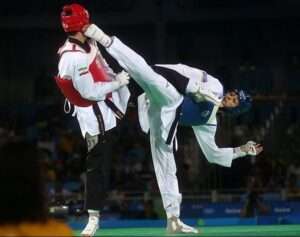
Taekwondo is a modern Korean martial art focused primarily on striking and kicking techniques, movement, timing, and practical fighting skills.
Modern Taekwondo places strong emphasis on kicking techniques, but also includes hand strikes, blocks, footwork, body movement, defensive techniques, and close-range applications. Training methods vary between organizations and schools, with different approaches to sparring, forms, self-defence, and competition.
Meaning of the Name
The name “Taekwondo” is commonly translated as “the way of the foot and fist”. The term combines “tae”, referring to kicking or striking with the foot, “kwon”, referring to the fist or hand, and “do”, meaning way or path.
The name reflects the central role of both kicking and hand techniques within the martial art.
Training Principles
Taekwondo training develops striking ability, movement, coordination, balance, timing, distance control, and physical conditioning.
Training commonly includes:
- Kicking techniques
- Hand strikes
- Blocking and defensive techniques
- Footwork and movement
- Distance and timing
- Partner drills
- Sparring
- Forms training
- Self-defence training
- Physical conditioning
Forms and Sparring
Forms are used to develop technical movement, balance, coordination, and control. Different Taekwondo organizations use different forms and terminology, including poomsae, tul, and hyung.
Sparring provides practical training in timing, distance, movement, defense, and striking against an active opponent. The rules and methods used in sparring vary between Taekwondo organizations and schools.
Technical Characteristics
Taekwondo is particularly known for its extensive use of kicking techniques. Training commonly includes front kicks, side kicks, roundhouse kicks, back kicks, hook kicks, axe kicks, and jumping or spinning kicks.
Hand techniques remain an important part of Taekwondo, including punches, strikes, blocks, and other defensive movements. The balance between kicking and hand techniques varies according to the organization, school, and training method.
Self-Defence
Taekwondo can also include practical self-defence training. Depending on the school and organization, this may include defensive techniques against strikes, grabs, holds, and other close-range attacks.
Self-defence training is not standardized across all Taekwondo organizations. Some schools place greater emphasis on practical applications, while others focus primarily on forms, sparring, or competition training.
Competition
Modern Taekwondo includes several different competition traditions. Competition may involve full-contact or controlled sparring, forms, breaking, and other specialized events depending on the organization.
World Taekwondo competition places strong emphasis on controlled kicking and striking techniques within a defined competition ruleset. Other Taekwondo organizations use different rules and may place greater emphasis on hand techniques, combinations, or other aspects of fighting.
Modern Development
Modern Taekwondo developed in Korea during the twentieth century through the development and organization of several martial arts schools, commonly known as kwans. These schools developed different curricula and traditions before Taekwondo became increasingly organized under national and international structures.
The modern Taekwondo system therefore contains several historical and organizational traditions rather than representing a single uninterrupted pre-modern Korean martial art.
Modern Position
Taekwondo is practiced worldwide as a modern martial art, combat sport, and system of physical training. Its training can include traditional forms, practical fighting methods, self-defence, physical conditioning, and competitive sparring.
The precise technical emphasis depends on the Taekwondo organization, school, and training method.
About The Author
